Concrete landscape curbing: what to decide before the pour
A poured curb is one of the few yard upgrades that makes weekly chores easier, but only if the layout suits your mower.
October 8, 2026 · 4 min read
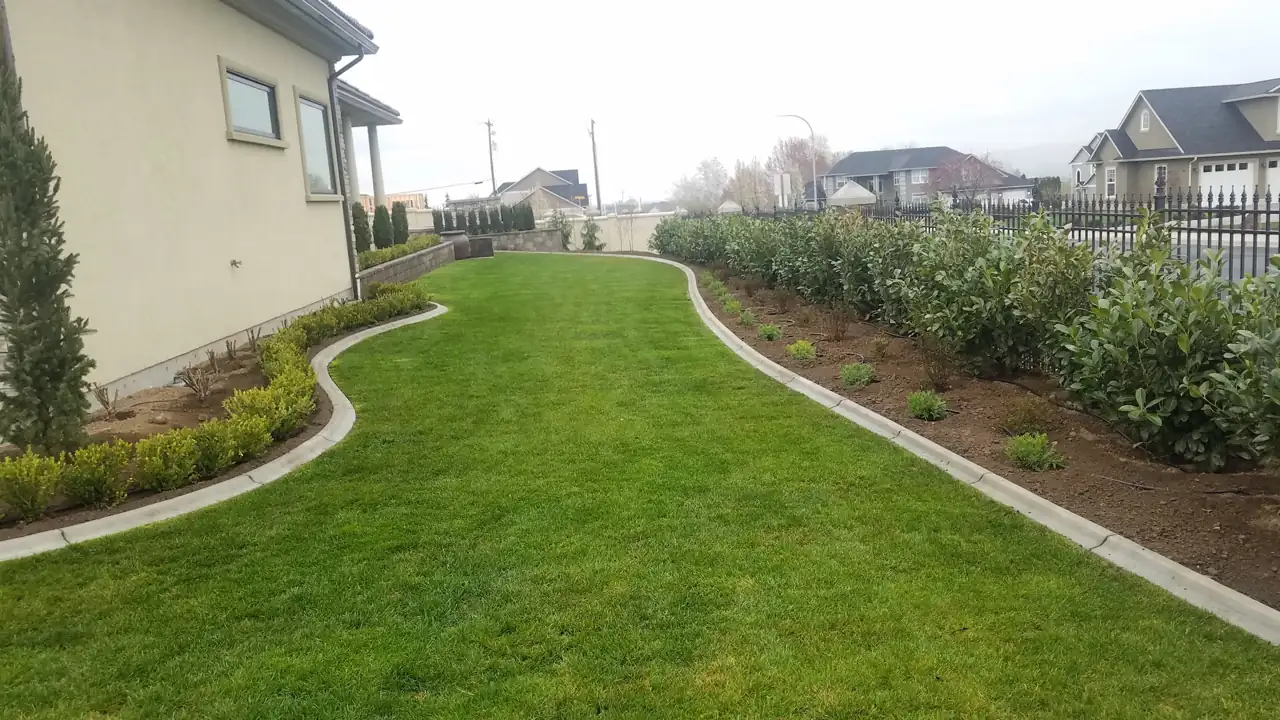
Why a poured curb beats loose edging
Plastic and steel edging works fine until the first hard winter. Frost heaves it, mower wheels catch it, and mulch finds its way underneath. A continuous concrete curb is one piece from end to end, so there's no seam for rock to creep through and no stake to work loose. It gives you a firm, flat line that holds a bed shape for years, which is why you see it around so many front-yard islands and side-yard beds in the Yakima Valley.
Wind is the other reason. Summers here are dry and breezy, and light mulch moves fast. A curb that stands a little proud of the soil catches it before it ends up on the lawn or the driveway. The same lip keeps river rock and basalt where you put it, and it blocks lawn grass from creeping into the bed, which is the chore you'd otherwise spend every June fighting with a spade.
How a curb changes mowing
The biggest payoff shows up on mowing day. A mower wheel can ride right along the top of a curb, so the deck cuts the grass tight to the edge without touching the bed. There's no string trimmer pass, no scalped patches, and no ragged line. The curb works like a guide rail, and the mowed edge looks crisp even when the person pushing the mower is in a hurry.
That only works if the geometry suits your equipment. Measure your mower deck before anyone sketches a layout. If a bed narrows to a few inches between the curb and a fence, the deck can't fit and you'll be trimming by hand forever. Keep any grass strip at least as wide as the deck, with a little extra, or plan to fill the narrow spot with rock and skip the lawn there.
Curves or straight runs
Gentle curves look good and mow easily. A wide, sweeping arc lets the mower follow the line in one smooth pass, and it softens the look of a big flat lawn. Tight curves and sharp inside corners are where trouble starts, because the deck can't turn that tight and you end up with a tuft of uncut grass in every pocket. A good rule of thumb is to draw curves you could comfortably steer a mower around, then redraw anything tighter.
Straight runs have their place. Along a driveway, a walkway or a fence line, a straight curb reads as tidy and intentional, and it's the fastest layout to mow. Many yards end up mixing the two: straight where the lot is formal, curved where the yard opens up. Whichever you pick, avoid lots of small jogs. Fewer, longer lines look better and mow better than a wiggle with a dozen corners.
Decide these things before the pour
Once the concrete is in, changing your mind means breaking it out. Settle these first:
- Bed shape and size, marked on the ground with a hose or spray paint and viewed from the street, the porch and the kitchen window.
- Mower deck width and the direction you'll mow, so every lawn strip is wide enough for a clean pass.
- Where the curb meets walkways, driveways and downspouts, so water has somewhere to go and doesn't pool behind the lip.
- Gaps or sleeves for sprinkler lines, drip tubing and any low-voltage lighting that has to cross the curb.
- What goes inside the bed: mulch, rock or plants, since that decides how high the curb should stand above the finished surface.
- Wheelbarrow access, so you can bring material in without lifting it over the curb every time.
Sprinklers, plantings and the curb
Plan irrigation before the curb, not after. Pipe and wire that need to cross the curb line are far easier to sleeve under the form than to chase through cured concrete. Spray heads at the lawn edge should clear the lip so they don't throw water into the bed or onto the pavement. If a bed gets drip irrigation, run the tubing so it can be pulled back to the curb for maintenance without kinking.
Think about plants too. Shrubs that spread should sit far enough back that they won't flop over the curb and hide the line. Roses, ornamental grasses and boulders all look good against a clean edge, and a curb gives a bed a natural stopping point so it never creeps outward season after season.
Mark it out before anyone mixes concrete
The most useful hour in the whole job is the walk-through with a garden hose. Lay the hose on the ground in the curve you want, step back, and look at it from the places you actually see the yard. Move it a foot. Look again. Picture mowing along it. Then paint the line. A curve that looks fine on paper often reads too tight or too fat on the lawn, and it's far better to find that out while it's still just a hose.
Talk it through with a crew
OMG Landscaping & Design installs curbing alongside beds, pavers, walls and sprinklers. Customer Jennifer Clampitt listed curbing among the work OMG has done for her, along with fencing, pavers, and sprinkler system installation and maintenance. When one crew plans the curb, the irrigation and the planting together, the pieces fit instead of fighting each other.
Planning a curbed bed in Yakima, Selah or anywhere nearby? Call (509) 307-8268 or use the contact page to set up a walk-through.
OMG Landscaping & Design LLC, (509) 307-8268
Call (509) 307-8268More articles
Planning a paver patio or fire-pit patio that stays level
A patio that looks great in year one and still looks great in year ten is mostly a story about what's underneath it.
Retaining walls for hillside yards: base, drainage, block
A retaining wall is a soil and water problem first and a design choice second, and the order matters.