Paver installation
Paver patios and walkways in Yakima, built from the base up
Patios, walkways, driveways, seat walls and fire-pit circles laid on a compacted base and locked in with a border band.
Chapter 01
A paver patio is mostly what you cannot see
Pavers that sink, rock or grow a low spot after the first winter almost always failed underneath. The stones were fine. The base was thin, wet, or never compacted, and the Yakima Valley is hard on a weak base: water gets in, freezes, heaves the surface, and thaws into a dip. Every patio the crew builds starts below grade, not on top of it.
Marco's crew excavates to depth with the mini excavator, takes out the topsoil and soft ground, and checks that the subgrade is firm before any rock goes in. Water has to have somewhere to go, so the surface is pitched away from the house and any wall it meets. A patio that drains properly is one you will still enjoy in January, when the freeze-thaw cycles are doing their worst.
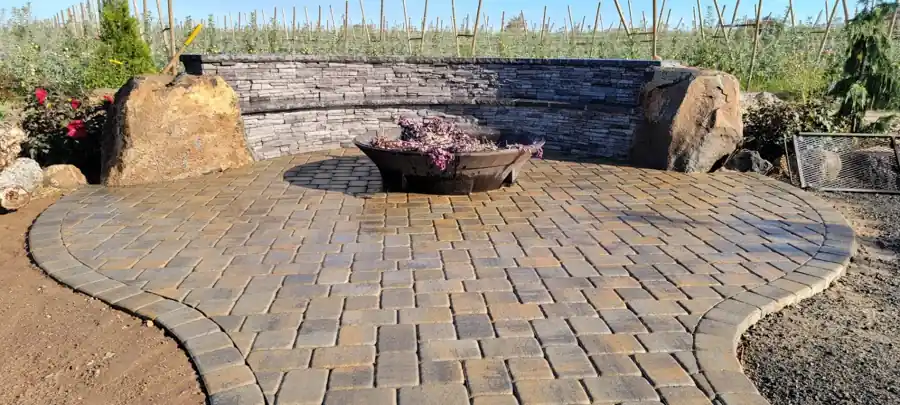
Round paver fire-pit patio with a stacked-stone seat wall and basalt boulders beside an orchard
Compacted base, bedding sand, and a border that locks it all in
Crushed base rock goes in lifts and gets compacted with a plate compactor between passes, then the bedding sand is screeded to a flat, even layer. Pavers are laid tight in the chosen pattern, working from a straight reference line so the joints stay true across the whole run. On curves and circles the stones are cut to fit rather than forced, which is what keeps a fire-pit ring looking drawn and not patched.
The edge is where a paver field lives or dies. Without edge restraint the whole surface slowly spreads and opens up. The crew sets restraint along every open side and often adds a charcoal soldier band, a single row of darker pavers framing the field. It looks sharp, and it does a job: it ties the edge down and gives the patio the same clean outline a poured curb gives a mulch bed.
Chapter 03
Seat walls, fire pits, walkways, then joint sand and care
A bare patio is just a floor. Stacked-stone and block seat walls turn it into a room, and a fire-pit circle gives it a center. These get their own compacted footing so a wall never leans on the pavers beside it. Walkways connect the pieces, from the driveway to the front door or from the back door across the lawn, with the same base and edge treatment as the patio. Hillside lots can take terraces, which is where a paver job and a retaining wall become one project.
Once the stones are down, joint sand is swept in and compacted, and swept again after the first rain, because it settles. Over the first season, top off any joint that has dropped, keep leaves and soil from piling at the edges, and keep an eye on any spot where water could run in underneath. Pavers are repairable by nature: lift one, fix the base, set it back. That is a real advantage over poured slabs.
Washington construction contractor, licence OMGLALD826BW, active since 2018. Commercial and residential.
Their patios
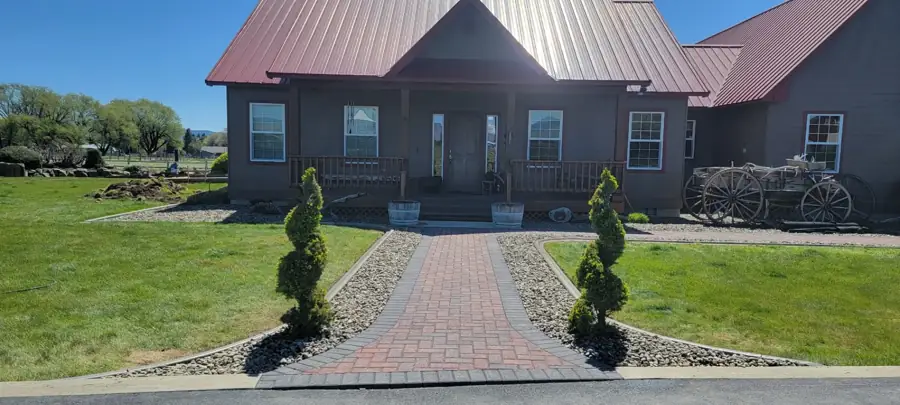
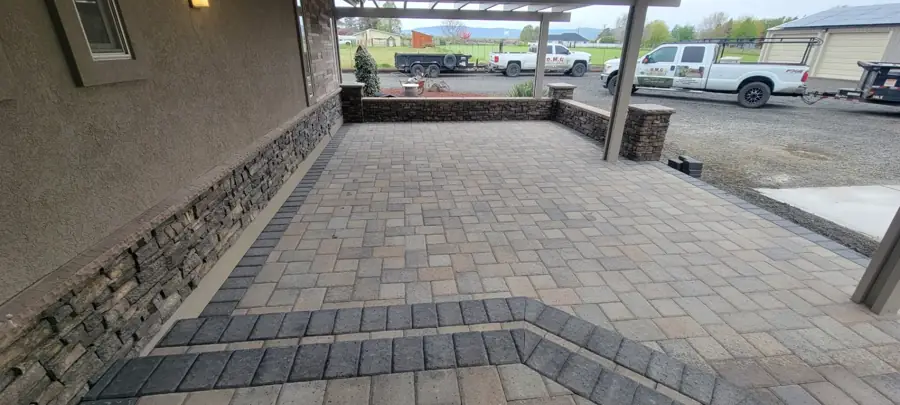
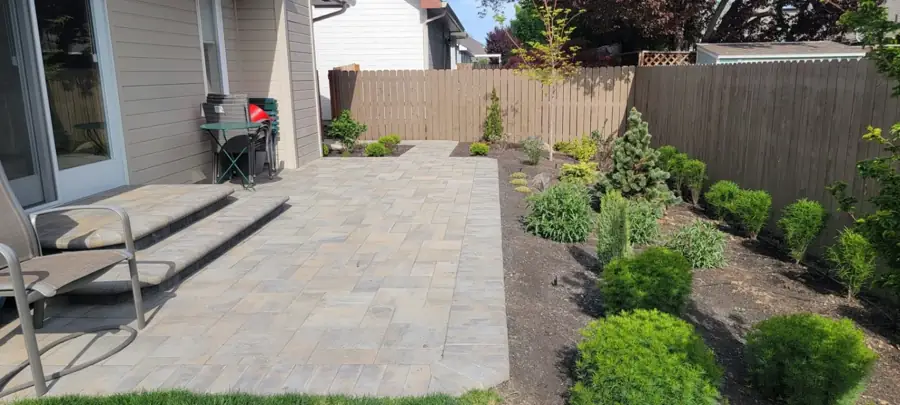
Fire-pit rings, border bands and brick walks from OMG jobs
Real patios the crew laid in the Yakima Valley, from a round fire-pit circle to a covered patio with seat walls.
“We have trusted OMG for over 15 years for a wide range of services, including fencing, pavers, curbing, and sprinkler system installation and maintenance.”
Patios usually sit inside a bigger plan. See how we handle the beds and lawn around a patio and the walls that make a sloped yard flat enough to build on.